
Faces in the Mirror, Stories in the Heart
When I arrived at the Jaffa flea market, I expected crates of fresh goods, haggling vendors, the smell of home-cooked food and maybe a few tourists taking photos. Like every colorful market I knew, I imagined a lively, cheerful experience.
Instead, I walked into chaos. Piles of old objects, cracked mirrors, coins from another era and people who really didn’t want their picture taken. The noise was overwhelming - voices overlapping, distant music, crowds pressing in. Even the smell, a mix of old dust and strong black coffee, was part of the scene.
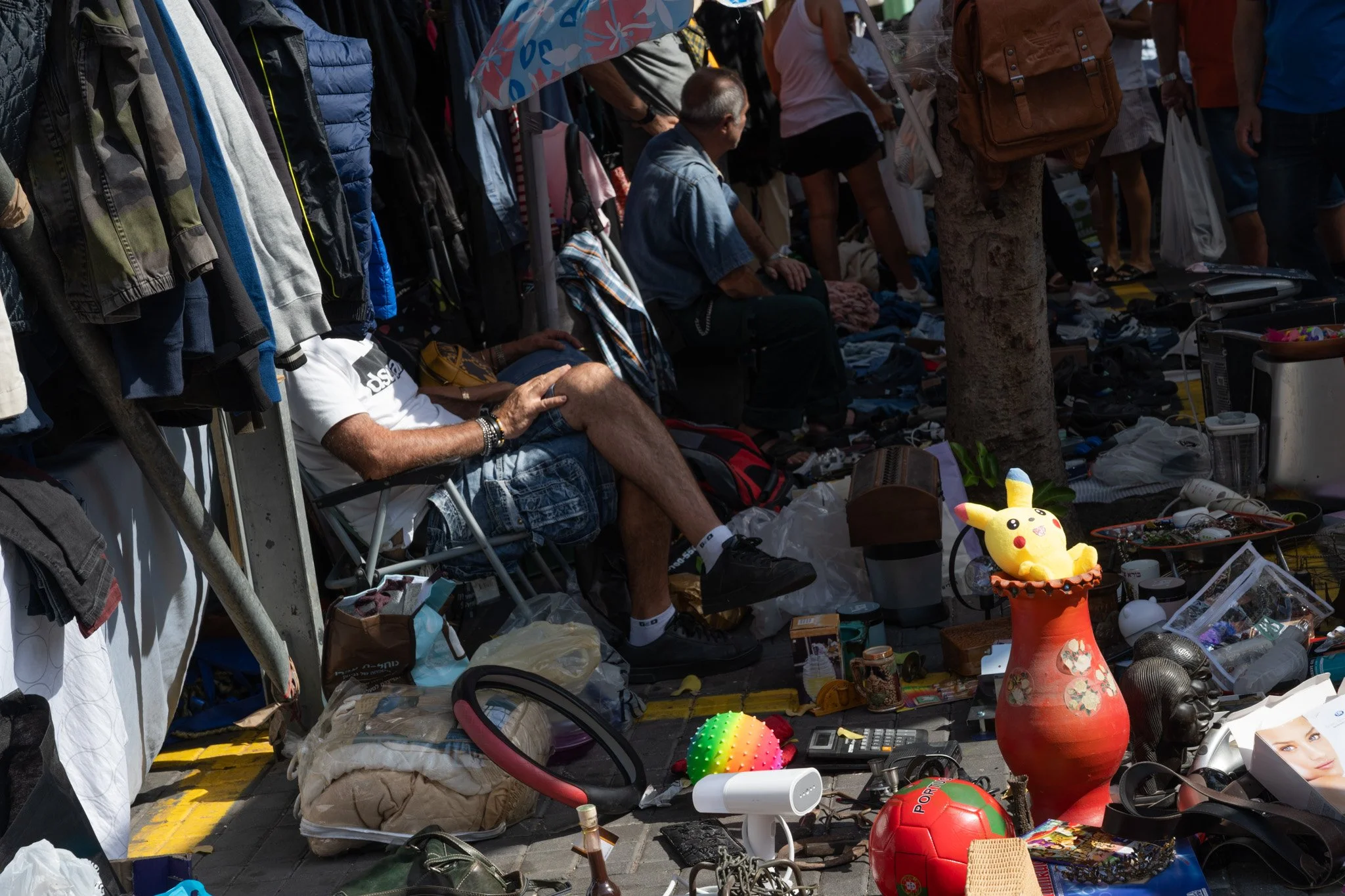
Somewhere behind the hanging jackets and piles of random objects, a vendor dozes in the shade, as a bright Pikachu guards his stall
For a moment I wondered if I would be able to tell any sort of story here. Then it hit me: the objects are only background. The people are the heart of the story.
I started photographing through mirrors. Not just to avoid confrontations, but to look for a truer reflection of whoever was in front of me. The mirror let me peek past the faces and into the soul, and for a moment I felt I wasn’t only photographing people, but their humanity.

Under a blue umbrella, one man sits with his back to us while another appears only in the mirror – a silent conversation framed by a walking cane
Little doors into big worlds began to open.
I met Asher Eliyahu, who comes to the market every Friday to help his friend who lost a leg in the war. “What can you do,” he shrugged, “friends are the most important thing.”
That kind of loyalty, so simple and obvious to him, reminded me how much we all depend on one another.
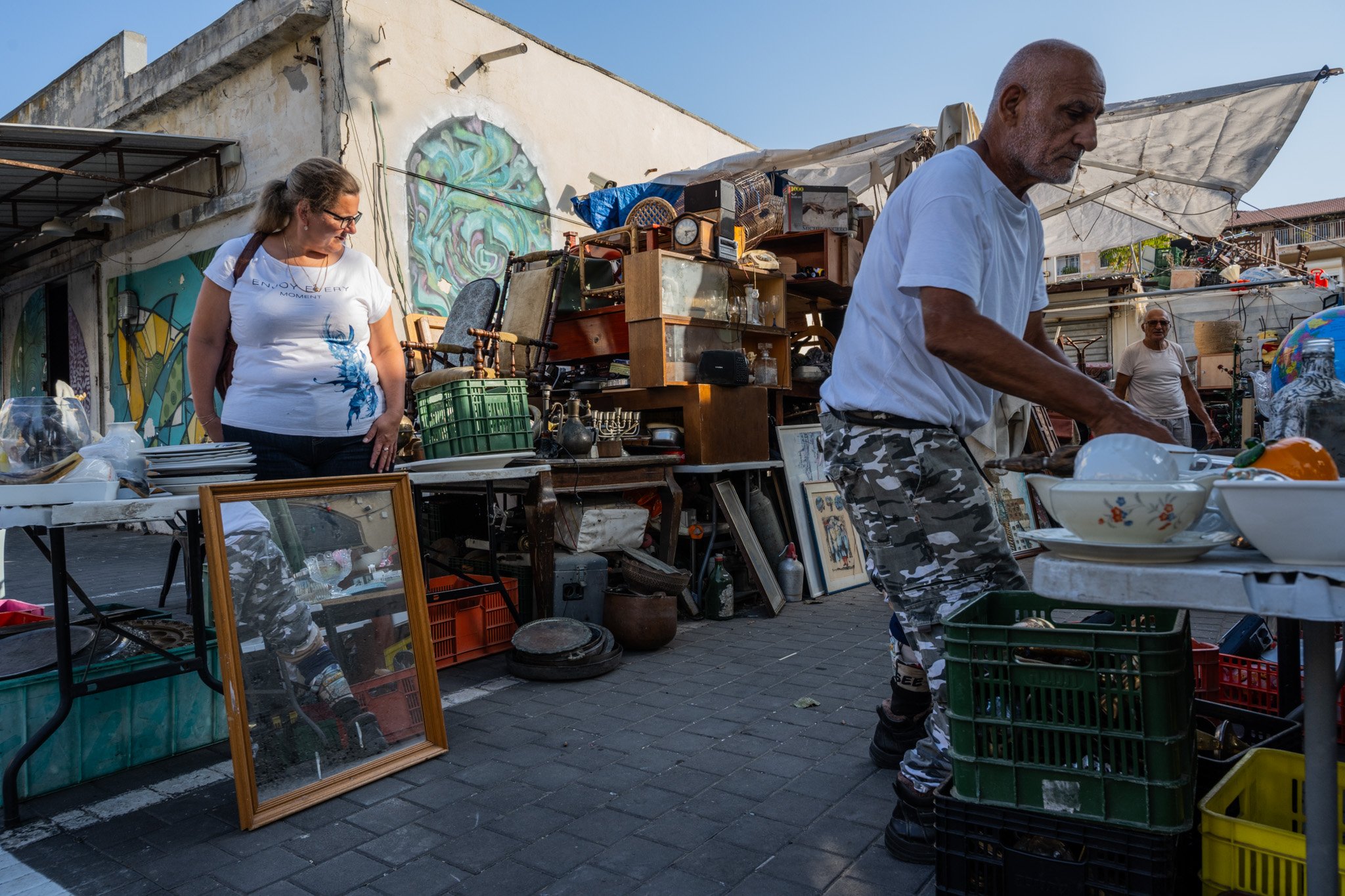
Asher Eliyahu, “What can you do? Friends are the most important thing”
Like many others I met that day, David Dahan – who calls himself “Dumaji” – carries a story you couldn’t invent. A colorful character who seems to have stepped out of a novel. He told me about his life as a lifeguard, a jewelry maker, a man who crossed continents and dealt in diamonds, married and divorced three times, and came back to Israel only to discover that here, too, life kept turning him upside down – including a missile that hit his home during the war with Iran.

Dumaji in stereo: facing the camera with a cigarette and hat, while his back is echoed in the mirror behind him
He sat in front of me, placed his hand on his head instead of a kippah, blessed the coffee and invited me to drink with him. I listened, mesmerized, as his long, tangled life unfolded like a movie.
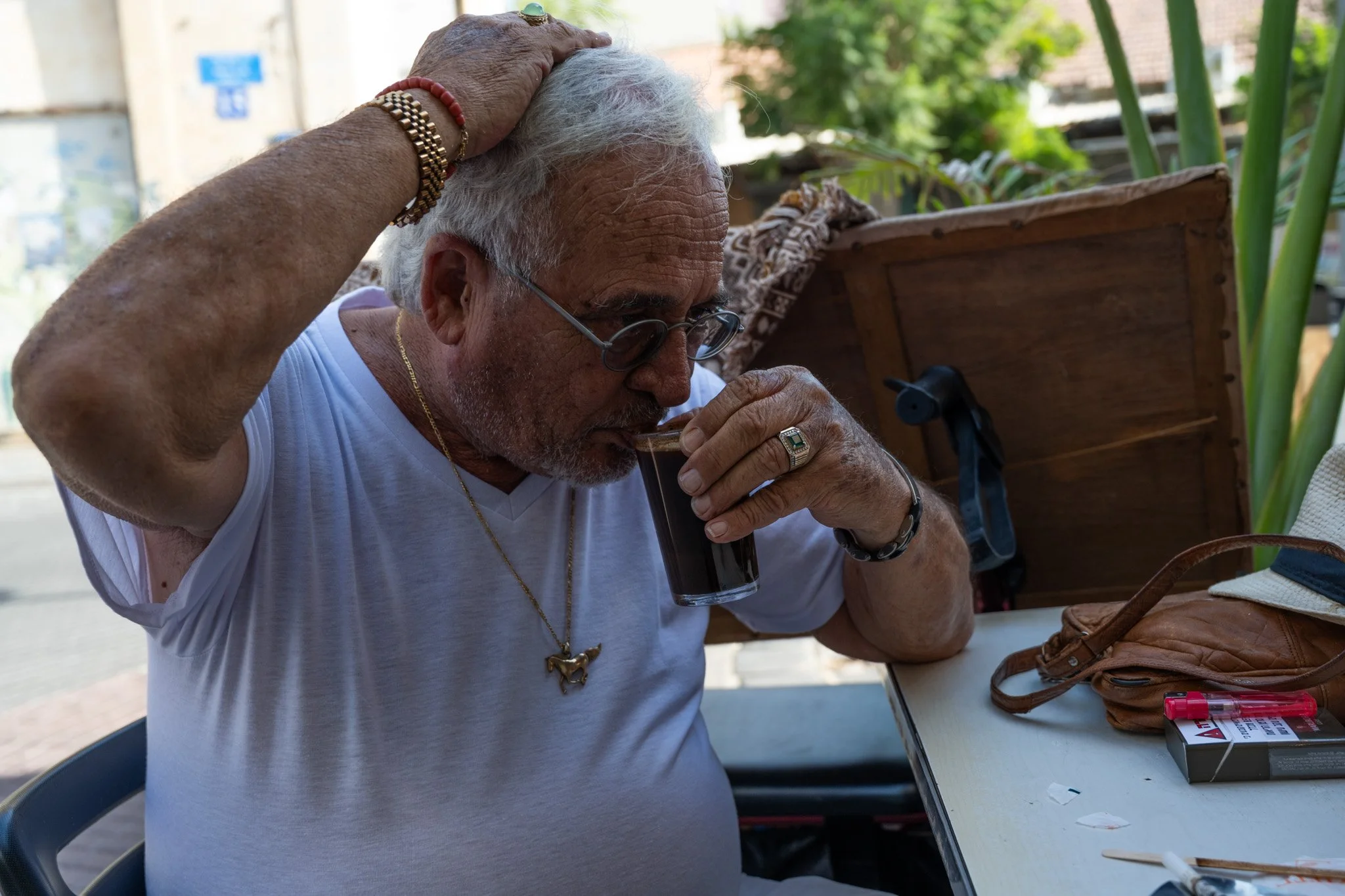
A rare pause – Dumaji places a hand on his head, blesses his strong coffee and takes a slow, thoughtful sip
In that moment I understood why I was there.
I went to the market with an imagined picture that turned out to be wrong, and came back with stories about people.
The flea market may be messy and rough, but inside it hides the human side of Tel Aviv: worn-out hearts, still full of light.
